Hidden Numbers in the Kimono Design
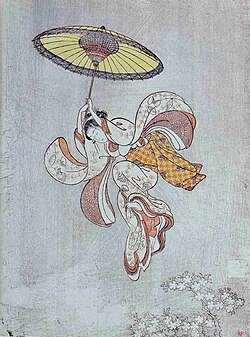
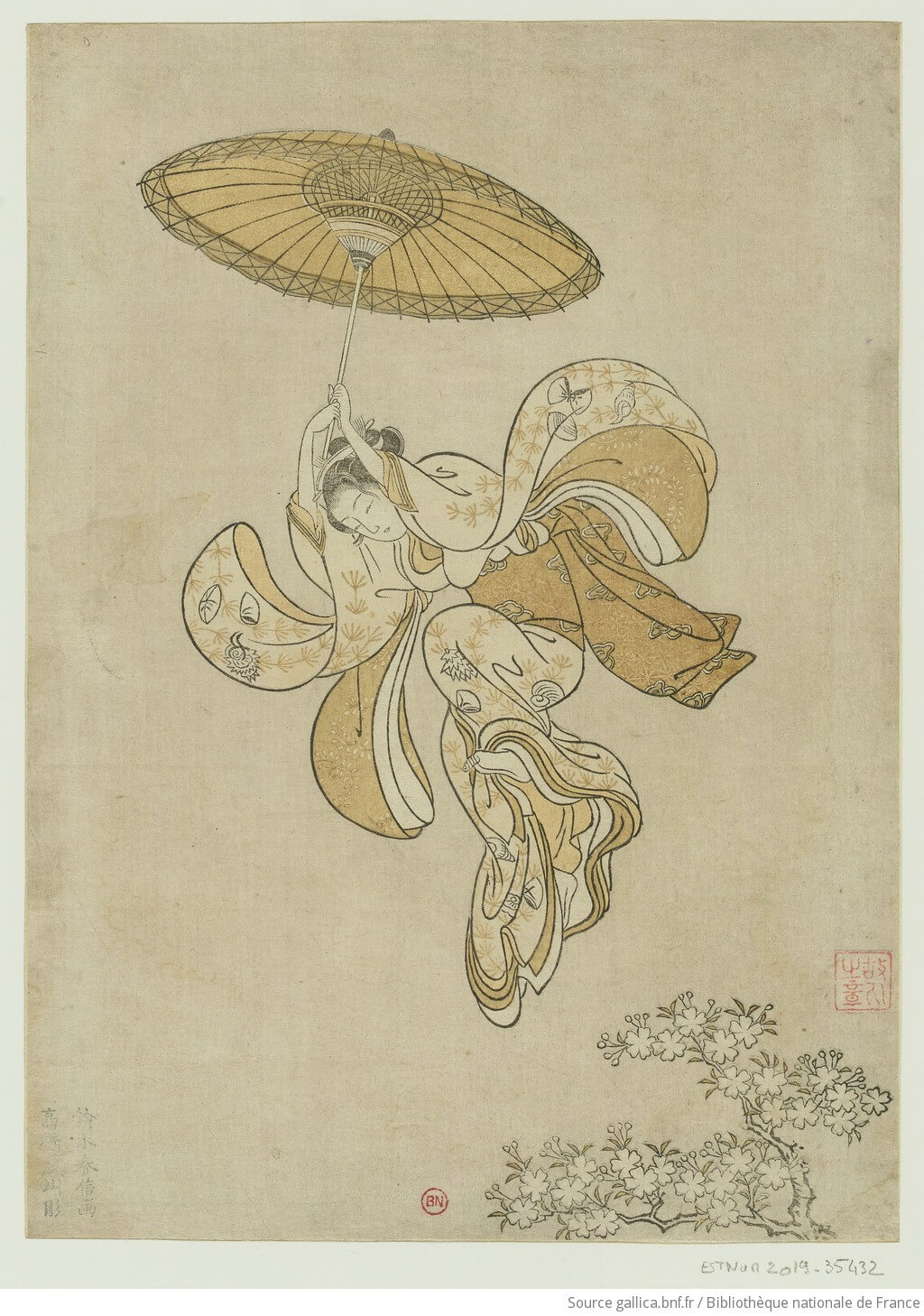
A young woman is jumping from the Kiyomizu Temple balcony, using an umbrella as a makeshift parachute.
Look closely at her attire—a series of hidden numbers is masterfully woven into the patterns and folds of her kimono.
Young Woman Jumping from the Kiyomizu Temple Balcony with an Umbrella as a Parachute
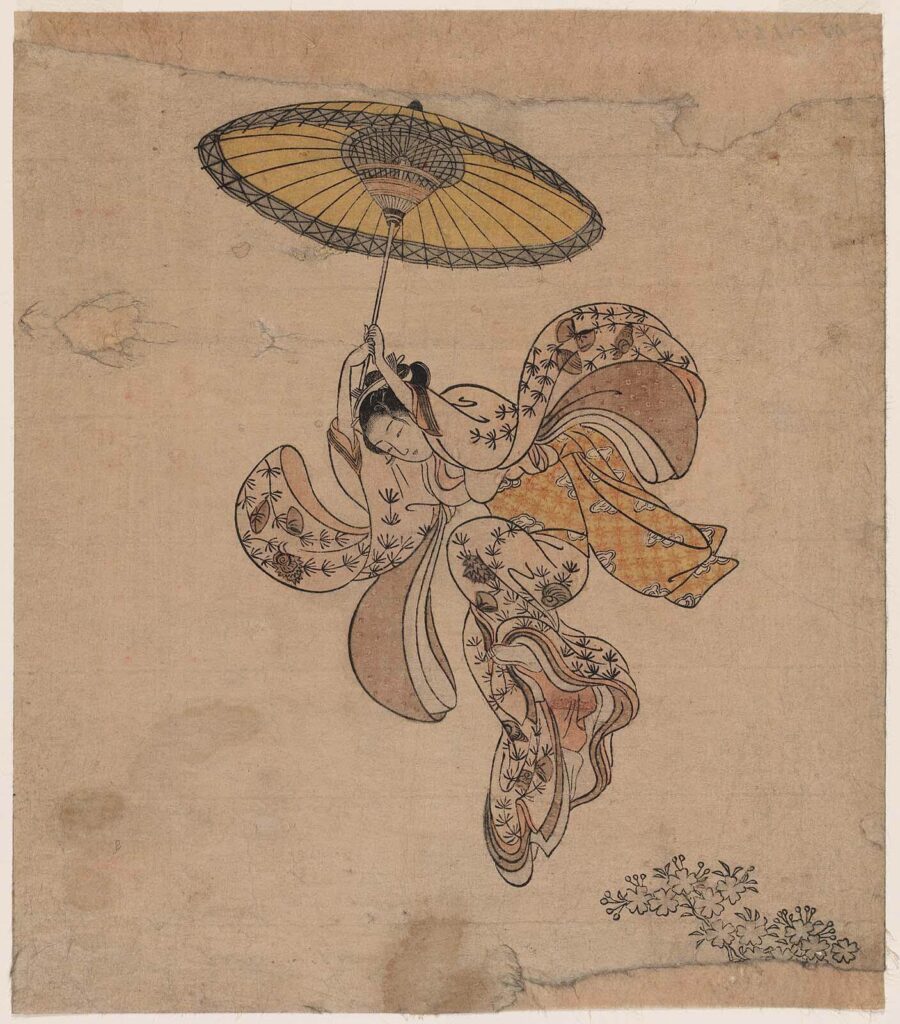
Source: Young Woman Jumping from the Kiyomizu Temple Balcony with an Umbrella as a Parachute
清水の舞台から飛び降りる女
Suzuki Harunobu (Japanese, 1725–1770)
Edo period
1765 (Meiwa 2)
Medium/Technique: Woodblock print (nishiki-e); ink and color on paper
Dimensions: 24 x 20.9 cm (9 7/16 x 8 1/4 in.)
Accession Number: 21.4598
Museum of Fine Arts Boston
Beauté sautant dans le vide depuis le balcon du temple Kiyomizu-dera
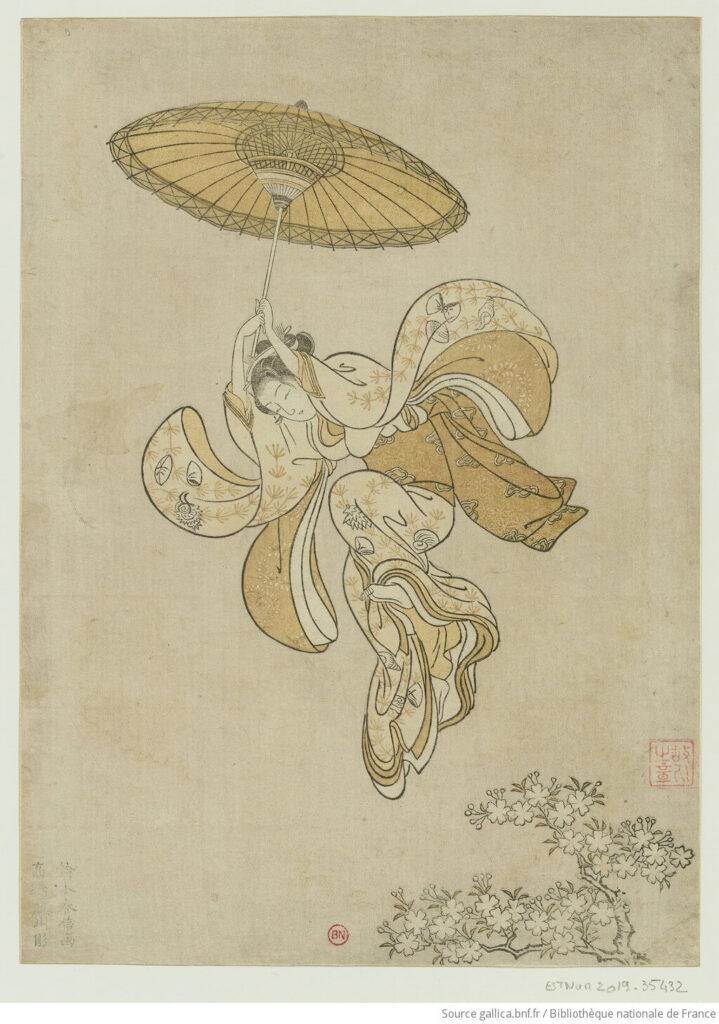
Source:« Beauté sautant dans le vide depuis le balcon du temple KiyomIzu »
[清水寺の舞台から飛び降りる女] ([1er état]) / 鈴木春信 画
[Kiyomizu-dera no butai kara tobioriru onna] ([1er état]) / Suzuki Harunobu ga
Auteur : Suzuki, Harunobu (1725-1770). Graveur
Identifiant : ark:/12148/btv1b100255590
Estampe-calendrier (egoyomi) réalisée pour la 2e année de Meiwa (1765)
Nishiki-e. Format chûban. 260 x 185 mm
Bibliothèque nationale de France
You might wonder, “Where exactly are they?”
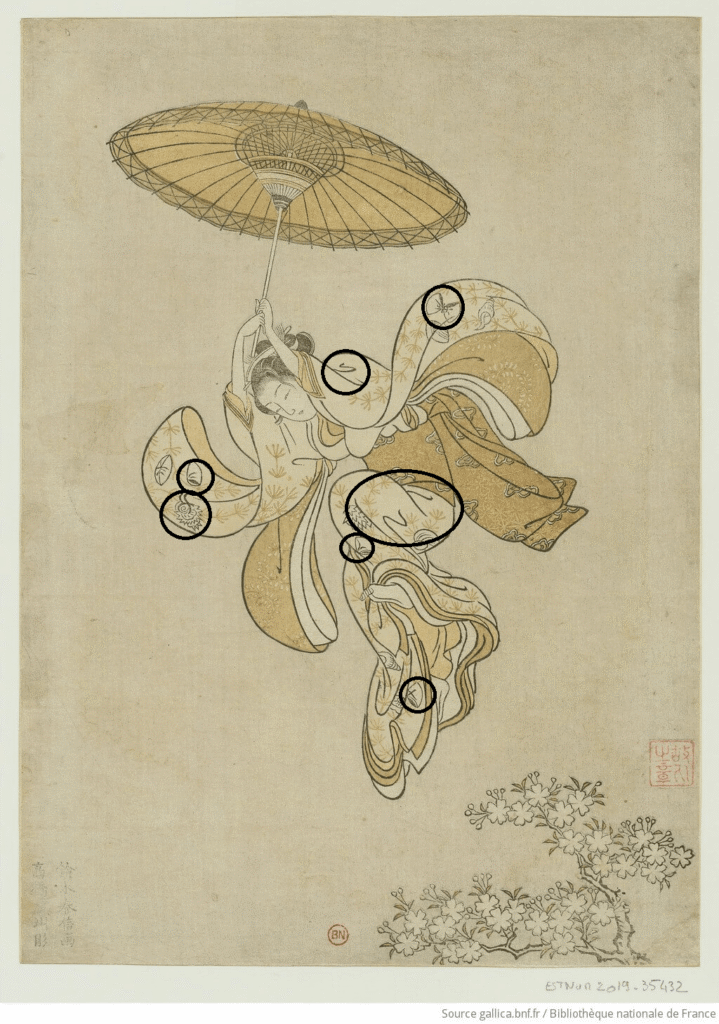
According to Masumi Horiguchi’s Ooedo Hanagata Eshi kurabe (Yamakawa Shuppansha, 2024), these characters and hidden numbers signify the “long months” (months with 30 days) of that specific year. The characters for “Dai” (meaning ‘long’ or ‘great’), along with the numbers 2, 3, 5, 6, 8, and 10, indicate that in this particular year, the long months fell on the 2nd, 3rd, 5th, 6th, 8th, and the 10th months of the lunar calendar.
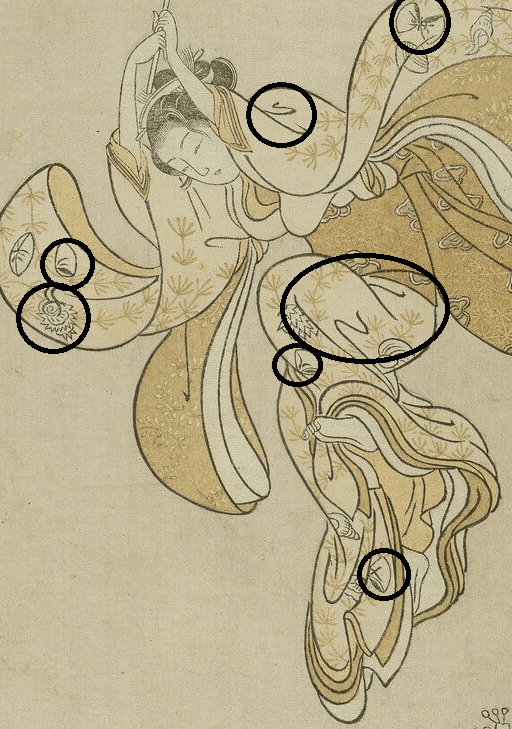
While the reference book includes marks to guide the reader’s eye, the following annotations are added by HANNA for further research and clarity.
Source:« Beauté sautant dans le vide depuis le balcon du temple KiyomIzu »
Source:« Beauté sautant dans le vide depuis le balcon du temple KiyomIzu »
Detail of the kimono design (Enlarged for research purposes)
Although the reference book does not pinpoint the exact location of every single digit on the shells, based on my visual analysis:
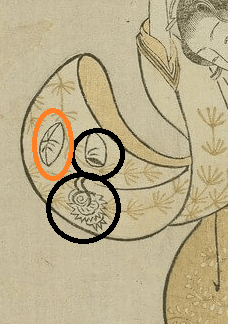
- Right sleeve: The characters 「二」 (2) and 「大」 (Long) can be seen.
- Left sleeve (inner side): Although not explicitly marked in the reference text, there is an unusual shell pattern that closely resembles the character 「三」 (3). I have highlighted this area in orange.
Source:« Beauté sautant dans le vide depuis le balcon du temple KiyomIzu »
Detail of the kimono design (Enlarged for research purposes)
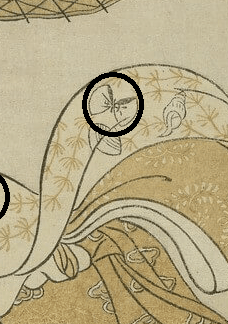
- Left sleeve: The character 「六」 (6) is visible.
Source:« Beauté sautant dans le vide depuis le balcon du temple KiyomIzu »
Detail of the kimono design (Enlarged for research purposes)
Source:« Beauté sautant dans le vide depuis le balcon du temple KiyomIzu »
Detail of the kimono design (Enlarged for research purposes)
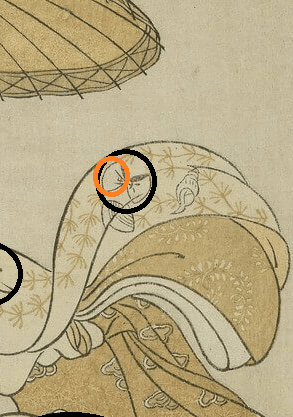
On the left side of the shell, it appears as though an inverted 「五」 (5) is hidden. What do you think?
Additionally, alternative interpretations suggest that the number 「五」 (5) might be subtly disguised within the layers and folds of the obi (sash).
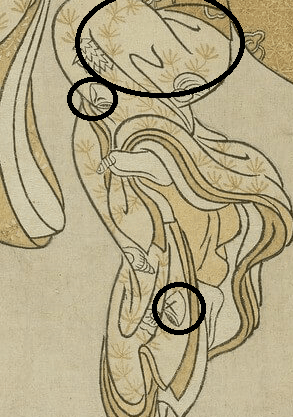
- On her leg: An inverted 「八」 (8) is integrated into the fabric design.
- Near the hem: The character 「十」 (10) is faintly inscribed.
Source:« Beauté sautant dans le vide depuis le balcon du temple KiyomIzu »
Detail of the kimono design (Enlarged for research purposes)
There is also a distinct mark near the young woman’s shoulder, but since it is not explained in the references I consulted, its meaning remains a matter of speculation. Perhaps it represents another 「二」 (2)? Furthermore, the crease on her leg could be read as a 「三」 (3), or it might even be interpreted as the zodiac character 「乙」 (Itsu / Kinoto).
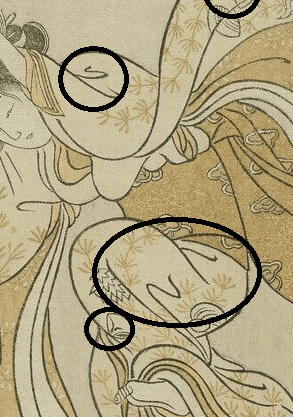
Source:« Beauté sautant dans le vide depuis le balcon du temple KiyomIzu »
Detail of the kimono design (Enlarged for research purposes)
However, based on the references I examined—including Ooedo Hanagata Eshi kurabe, Masako Tanabe’s Suzuki Harunobu: Evolving Edo Aesthetics, and the official documentation by the Bibliothèque nationale de France (BnF)—the hidden characters are explicitly listed as “Dai, 2, 3, 5, 6, 8, 10.” Therefore, it seems likely that the character is not 「乙」.
Finding these hidden numbers within prints was a highly fashionable pastime for the literate elite of the period. I look forward to exploring the various ongoing academic debates regarding these hidden motifs in a future post.
What Are “Long Months”? Why 2, 3, 5, 6, 8, and 10?
Semblable à un oiseau ou plus encore à un papillon, la jeune fille suspendue à son ombrelle vient de sauter dans le vide, du haut de la terrasse du temple KiyomIzu. Si les dieux sont favorables à ses amours, elle arrivera sans mal, comme il se doit, sur le cerisier, au fond du vallon. Selon la légende, le souhait formulé pouvait aussi concerner une guérison.
Harunobu trouve dans ce thème l’occasion de représenter une figure volante, dans un déploiement d’étoffe en mouvement. Il en fait un sujet d’egoyomi, estampe de calendrier. Les mois longs (2e, 3e, 5e, 6e, 8e, 10e) sont inscrits sur les coquillages, ainsi que le mot « long ».Jusqu’en 1765, l’édition des « images de calendriers » (daishô-goyomi), images très fonctionnelles, était un monopole d’État. La première connue date de 1686. Seuls un petit nombre d’éditeurs officiels étaient autorisés à les publier. Jusqu’à l’introduction du calendrier grégorien, le nombre de jours dans le calendrier lunaire variait.
La prévision des mois longs et des mois courts facilitait les autres calculs calendaires. Au cours de la deuxième et troisième année de l’ère Meiwa (1765-1766), des images plus luxueuses, éditées en grand nombre dès 1765, se répandirent au Nouvel An, suivant une tradition attestée dès 1724. Elles annonçaient avec subtilité et discrétion, parfois sous forme de rébus, les mois longs de l’année. Les chiffres, assimilés à des motifs décoratifs, étaient à découvrir dans l’image.
Image de calendrier « Beauté sautant dans le vide depuis le balcon du temple KiyomIzu »
Summary of the Official Commentary by the Bibliothèque nationale de France (Translated and curated by the author):
Composition: Like a bird or a butterfly, a young girl leaps into the void from the terrace of Kiyomizu-dera, suspended by her umbrella. If the gods favor her romance, she will land safely on the cherry trees in the valley below. Harunobu used this dynamic theme of a flying figure to craft an egoyomi (calendar print), cleverly concealing the long months (2nd, 3rd, 5th, 6th, 8th, and 10th) along with the character for “long” within the shell motifs of her moving drapery.
Historical Context of Calendars: Until 1765, the publication of these functional calendar prints (daisho-goyomi) was a strict state monopoly, with only a few authorized publishers. Under the lunar calendar used before the introduction of the Gregorian system, the number of days in each month fluctuated every year. Knowing the sequence of long and short months was essential for daily life. During the Meiwa era (1765–1766), luxurious prints began to circulate widely at New Year gatherings, subtly announcing the long months through clever visual riddles (rébus) woven into the decorative motifs.
During the Edo period, Japan operated under the traditional lunisolar calendar.
At the dawn of the Meiwa era, a sophisticated cultural phenomenon emerged among wealthy merchants and samurai intellectuals: the Daisho-kai (calendar exchange parties). These gatherings were dedicated to exchanging privately commissioned egoyomi (pictorial calendars).
This intellectual play of disguising the year’s calendar layout within beautiful illustrations was the direct catalyst for the birth of full-color nishiki-e (brocade prints).
”Under the lunar calendar, a ‘long month’ consisted of 30 days, while a ‘short month’ consisted of 29 days, and their sequence changed every single year. Egoyomi were stylishly designed prints that cleverly hid these changing sequences within the artwork itself. In the highly celebrated calendar prints of Meiwa 2 (1765), the long months followed the sequence of ‘Dai (Long), 2, 3, 5, 6, 8, 10,’ while the short months were ‘Sho (Short), 1, 4, 7, 9, 11, 12.’ Alternatively, characters indicating the zodiac year, such as ‘Meiwa 2, Kinoto-Tori (Year of the Rooster),’ were hidden somewhere in the composition.”
— Masako Tanabe, Suzuki Harunobu: Evolving Edo Aesthetics (Tokyo Bijutsu, 2017, p. 28)
As noted above, the length of the months varied annually. In the year 1765 (Meiwa 2), which was the Year of the Rooster (酉年 – Tori-doshi) in the sexagenary cycle, the long months were designated as the 2nd, 3rd, 5th, 6th, 8th, and the 10th months.
A Sophisticated Intellectual Game: Decoding Visual Riddles
In the official commentary by the Bibliothèque nationale de France (BnF) quoted earlier, the expression “parfois sous forme de rébus” is used. The French word “rébus” (corresponding to “rebus” in English) refers to a picture puzzle, a visual riddle, or a wordplay puzzle.
It represents a genre of art that cannot be fully decoded or appreciated without a certain level of knowledge, education, and cultural literacy.
A prime example of this in Western art history is a famous 16th-century masterpiece:
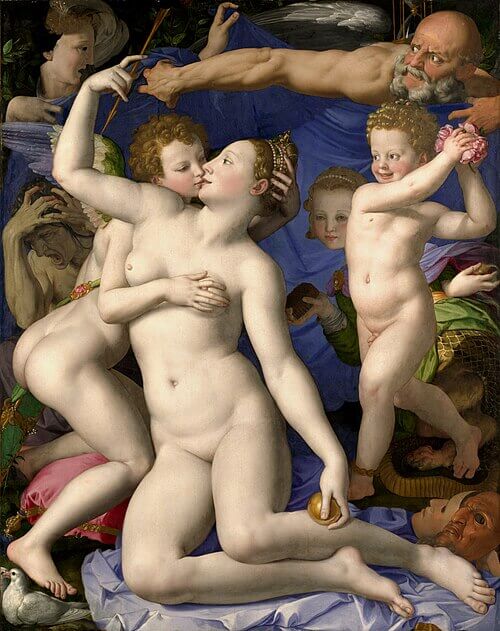
Source:Angelo Bronzino – Venus, Cupid, Folly and Time – National Gallery, London
National Gallery, LondonAn Allegory with Venus and Cupid
The culture of “rebus” (visual riddles)—wherein letters, hidden meanings, and biting humor are woven into an artwork—was deeply cherished in 16th-century Europe as a form of political satire and a parlor game for the royal courts, right around the time Bronzino was active.
It is fascinating to realize that this kind of “intellectual game for the elite” via the visual arts was independently embraced and enjoyed by intellectuals and cultured circles across both the East and the West.
The Proverbial Leap: “Jumping off the Stage of Kiyomizu”
There is a famous Japanese expression derived from the title of this artwork: “To jump off the stage of Kiyomizu” (Kiyomizu no butai kara tobioriru), which means to take a bold, decisive plunge.
Regarding Suzuki Harunobu’s Young Woman Jumping from the Kiyomizu Temple Balcony with an Umbrella as a Parachute, Masako Tanabe writes in Suzuki Harunobu:
“The young woman in a long-sleeved kimono (furisode), leaping gracefully with a parasol in hand, is widely recognized as jumping from the famous balcony of Kiyomizu-dera. While the cherry blossoms symbolize Kiyomizu Temple in Kyoto, this imagery was also a popular theatrical device in performing arts like Kabuki. In fact, an earlier work by Ishikawa Toyonobu also depicts a young woman leaping with an umbrella against the backdrop of the Kiyomizu balcony.”
— Masako Tanabe, Suzuki Harunobu: Edo no Omokage wo itooshimu (Tokyo Bijutsu, 2017, p. 32)
As noted above, the cherry blossoms represent Kiyomizu-dera, while the act itself served as a highly dramatic device in theatrical performances. It certainly makes for a visually striking composition.

Source:Harvard Art MuseumsWoman with Parasol Jumping from Balcony of Kiyomizu-dera
But did people actually jump from the balcony of Kiyomizu-dera in real life?
“Tobiochi”: Leaping from the Balcony in the Edo Period
Historical records from the Edo period—specifically the Kiyomizu-dera Joju-in Nikki (diaries spanning from 1694 to 1864)—reveal that there were over 200 documented cases of people jumping from the balcony, including attempted leaps. Remarkably, the survival rate was approximately 85%.
These leaps were not driven by a desire for self-destruction, but rather by deep religious devotion. People made these perilous jumps as a form of gan-gake (a solemn prayer to the deities), earnestly seeking the intercession of the Kannon Bodhisattva for miracles, such as the healing of illnesses.
(Note: For a more detailed exploration of the motivations and historical background behind this “Tobiochi” phenomenon, please refer to my dedicated post: “Tobiochi: The Maidens Who Leapt from the Stage of Kiyomizu”)
Kiyomizu-dera has long been revered as a sacred site of Kannon worship.
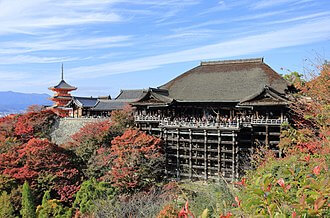
引用元:Kiyomizu-dera Martin Falbisoner CC-BY-SA-4.0
Driven by profound faith and intense personal prayers, people undertook the act of tobiochi from this very balcony. In 1872 (Meiji 5), the Kyoto prefectural government officially banned the practice, and this unusual custom gradually died out.
Image Credits & Disclaimer:The high-resolution images above are sourced from the public domain archives of the Museum of Fine Arts, Boston, the Bibliothèque nationale de France (BnF) and The Harvard Art Museums. This article is published exclusively for non-commercial, educational, and cultural research purposes. This website carries no advertisements or monetization to preserve the integrity of art history documentation.
NIKKEI
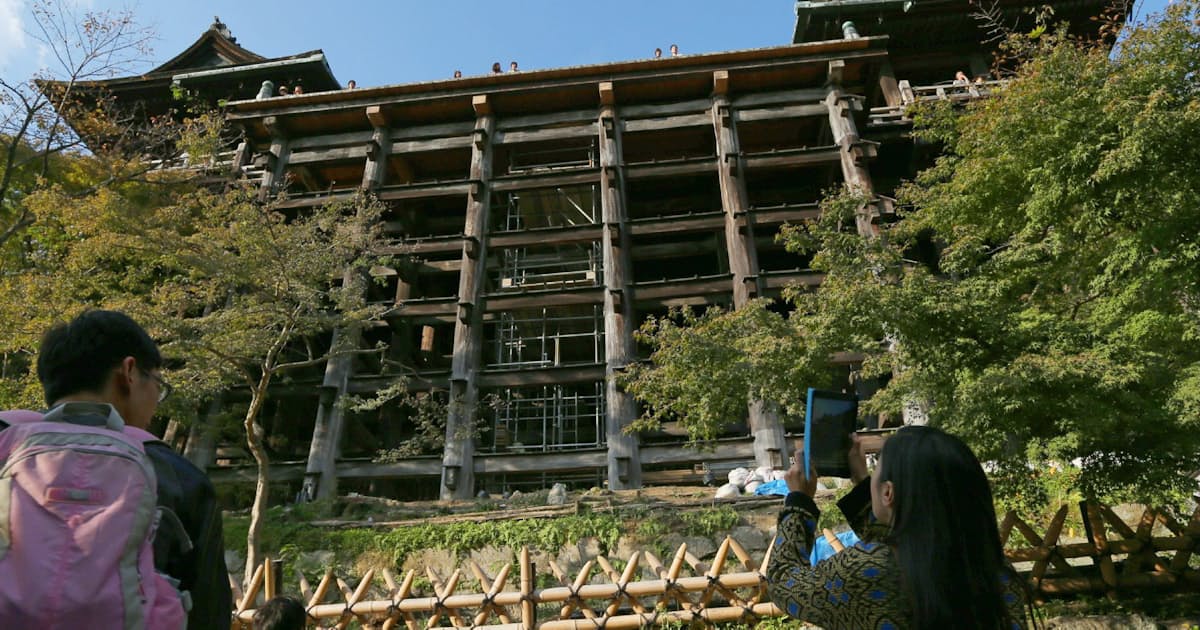
“Tobiochi: The Maidens Who Leapt from the Stage of Kiyomizu”)
🔗 Read the full detailed analysis with source origins in Japanese:


- Masako Tanabe, Suzuki Harunobu (鈴木春信 江戸の面影を愛おしむ). 2017, TokyoBijutsu, ISBN978-4-8087-1080-4
- Masumi Horiguchi, Ooedo Hanagata Eshi kurabe (大江戸花形絵師競 おもしろすぎる!浮世絵案内), 2024, Yamakawa Shuppansha, ISBN978-4-634-15256-4